US orders three more F-35 test-bed aircraft to avoid testing capability gap

April 30, 2026

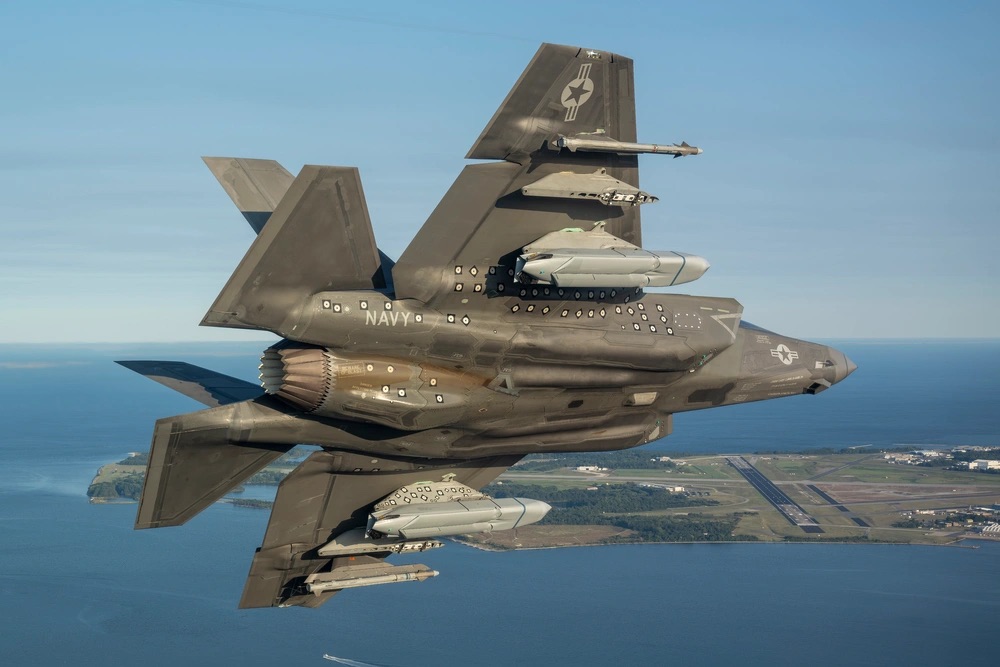
After over a decade of intensive test flying, the original science F-35 test-beds are now starting to age out. To prevent a testing capability gap, Washington is ordering an extra three F-35 test-bed aircraft.
US orders three more test F-35 aircraft
According to a Defense Blog article, the Pentagon has awarded Lockheed Martin a $177.5 million contract modification to design and build three new F-35 flight science aircraft.
A small share of the funding is from programme partner nations. Most of the work will be carried out in the US, with Fort Worth having the largest share (30%). The UK is to have a 20% share as BAE Systems is a major contractor to the programme. Denmark is to get a 5% share.
These new aircraft are to include one example of each variant, namely the conventional F-35A, the STOVL F-35B, and the carrier-based F-35C. They are expected to be delivered by 2031.
Defense Blog reports this is part of efforts to “prevent a testing capability gap and prepare the program for its next major upgrade block.”
The Pentagon in its budget request says it can speed up fielding of the F-35's Block 4 by a year, to 2030, as it increases spending on the program. This is reliant on reconciliation approvalhttps://t.co/F5NdnDxpKT
— Brian Everstine (@beverstine) April 22, 2026
It is a modification to an existing cost-plus-incentive-fee contract and “covers all touch labor and reach-back engineering needed to produce the three replacement aircraft.”
Get the latest aerospace defence news here on AGN.
The testbeds are not combat F-35s
These aircraft will not be combat F-35s and are to be purpose-built/modified to measure and validate aerodynamic, structural, and performance characteristics.

As new major software and hardware upgrades are developed, these flight science aircraft will serve as controlled test beds. They will function to generate the needed data to certify the upgrades for operational use.
Defense Blog also notes, “They fly edge-of-envelope profiles that would be too risky or too instrumentation-intensive for standard production jets.”
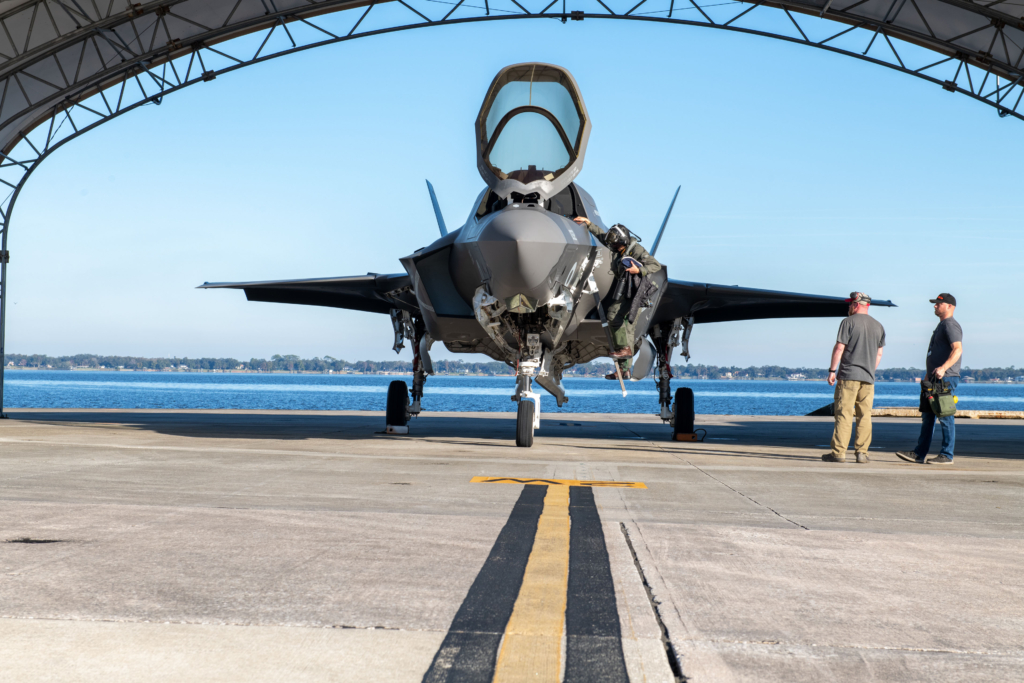
By replacing the original testbed F-35s now, a capability gap can be avoided as the F-35 programme moves toward “holistic testing” of the Block 4 capabilities that are set to dramatically increase the F-35’s capabilities.
Moving forward with the significant Block 4 upgrade
With the teething issues of the Technology Refresh 3 upgrade now mostly resolved, the F-35 can move forward with its Block 4 upgrade.
The Block 4 upgrade is a sweeping package of software and hardware improvements that will expand the F-35’s weapons carriers, sensor integration, EW capabilities, and pilot interface.
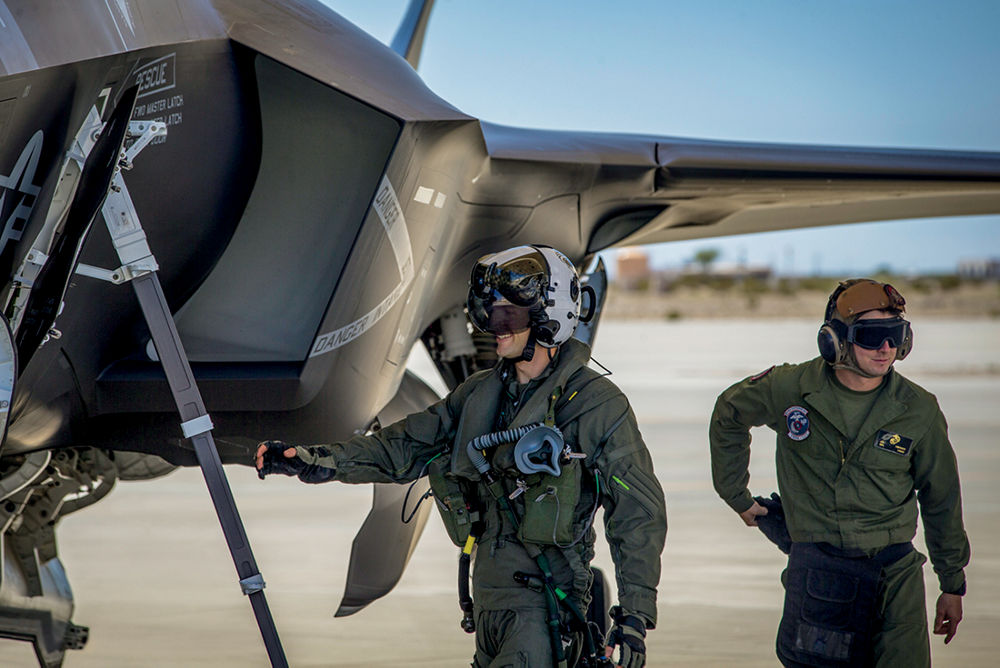
These jets are to have dramatically more computing and processing power, while the Engine Core Upgrade will boost electrical power generation.
Upgrades are rolling out incrementally. One example is the much more powerful next-generation APG-85 radar, which has not been cleared for export.
Delivery of the first fully-configured Block 4 upgraded jets is now expected in 2031, around five years behind schedule.
While the media often likes to talk about 4th-, 5th-, and 6th- generation aircraft as distinct categories, these are more marketing terms and easily understandable clickbait.
In practice, fighter jets are built for different roles and exist along a very complicated spectrum. A fighter jet (e.g., the F-15EX) may have advanced next-generation avionics and computers but not stealth, while another (e.g., Su-57) may have improved stealth, but less advanced avionics and computers.

The upcoming 6th-generation Tempest/GCAP will likely have to compete with a future Block 5 upgraded variant of the F-35. Its point of reference would likely be a future evolution of the F-35 rather than the F-47 in development.
Featured Image: USAF